
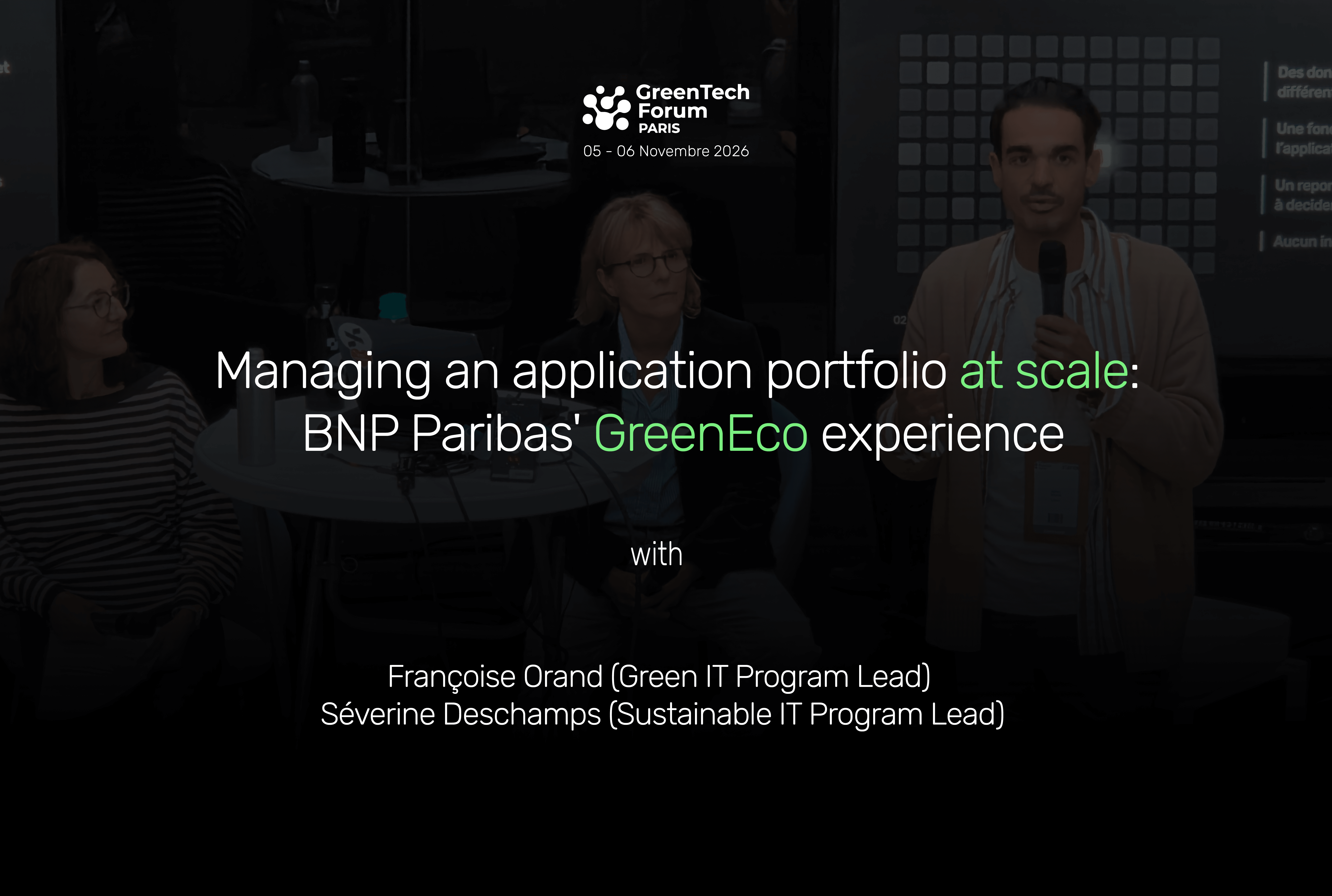
Measuring the footprint of thousands of applications within a bank, with its strict security requirements and multiple layers of governance, is about much more than technology.
On November 5, at the GreenTech Forum, Françoise Orand and Séverine Deschamps, who lead BNP Paribas' Sustainable IT program, shared how the bank approached this challenge with GreenEco. How do you integrate a startup into a bank's information system? Who makes the decisions, and at what level? And how does a recommendation eventually make its way into an application team's backlog?
The starting point
In a large organization, servers, clusters and cloud bills are relatively easy to track. What is much harder to see is how much a specific application actually consumes.
Data is scattered across infrastructure, cloud, mainframe and monitoring tools. FinOps teams tend to look at resources rather than applications. Meanwhile, carbon reporting typically happens once a year, with figures consolidated after the fact: too late to inform day-to-day decisions.
As a result, the teams building and running applications have no dedicated indicators to understand their own impact. This is the blind spot BNP Paribas set out to address.
What is GreenEco?
GreenEco grew out of a pilot project between BNP Paribas and Sopht. It is a Sopht module designed to measure and reduce the environmental and financial costs of applications.
The approach comes down to three key actions:
- Measure first. Infrastructure and service metrics are collected automatically through APIs. This makes it possible to assess thousands of applications, something that would simply not scale with manual calculations.
- Then decide. Each application receives an eco-score based on five criteria, alongside recommendations quantified in both CO₂e and euros. These include CPU and RAM right-sizing, Kubernetes resource adjustments and decommissioning.
- Finally, prove the impact. Every action is tracked, from the initial recommendation through to implementation. Data collection is supported by a technology partnership with Dynatrace.
Getting started at BCEF
It all began at BCEF, BNP Paribas' French retail banking entity. In 2023, Françoise Orand was leading its Sustainable IT program. She chose to work with a startup the group already knew: in 2022, Sopht had joined B!UP Accelerate, BNP Paribas' accelerator at Station F.
The project started with a one-year pilot involving BCEF IT, which led to the creation of GreenEco. By 2025, its value had been demonstrated, and other entities within the group were showing interest. In 2026, more than 100 applications are being tracked at BCEF, while the rollout has also started at ITTF.
The obstacles: not technical, but organizational
This was one of the strongest messages from the session: the technology itself was never the main obstacle. The challenges were organizational.
The first hurdle was security. Integrating a startup's SaaS platform into a bank's information system requires substantial groundwork. This involved a formal security assessment, encrypted data exchanges, redesigned data-transfer flows and single sign-on.
The second was governance: who makes the decisions, who gathers the data, and who takes action? The answer was a three-party RACI framework involving BCEF's Sustainable IT business team, BCEF IT and Sopht, which provides the platform and its expertise. This framework also ensures continuity when team members change.
The third challenge was pace. A startup and a large organization don't operate at the same speed. Regular meetings, a dedicated point of contact on each side and a deliberately limited initial scope helped both parties move forward together.
The fourth challenge is still there, and Séverine Deschamps was candid about it: application squads do not yet have CO₂ targets in their annual objectives. In the meantime, BNP Paribas is addressing this through the eco-score, closer ties with FinOps and by bringing the topic to business committees. As one ITTF application team put it: "What speeds up decisions is also the financial side."
Putting governance in place
When Séverine Deschamps took over the program at BCEF in July, she inherited a governance structure that already extended all the way to operational teams.
At the top, a quarterly BCEF IT steering committee oversees the program, with a cross-entity committee set to join it soon. Every two weeks, GreenEco leads from the different entities coordinate their efforts. Weekly operational meetings bring business stakeholders together, while a review is held before every production release.
At the end of this chain are the squads: the application teams themselves. They are responsible for reviewing their eco-scores and deciding which actions to take. To make adoption sustainable, BNP Paribas relies on one lead per domain, a formal onboarding process and a dedicated training program.
A concrete example: 35% less CO₂e in 15 days
With GreenEco, a recommendation doesn't become just another line in a report that nobody reads. It turns into a task in the team's backlog, just like any other piece of work.
Here is the example shared during the session. An application team had a non-production Kubernetes environment used for development and testing, with far more computing resources reserved than it actually needed. GreenEco recommended cutting those reserved resources (CPU and memory) by half. Before making a decision, the team could see the expected savings in both CO₂e and euros.
The team discussed the recommendation in a workshop and implemented the change the very next day. Fifteen days later, the measurements confirmed a 35% reduction in emissions (CO₂e) from the services concerned.
The speakers also shared an important lesson from the field: reducing the resources reserved by an application is not always enough. If an application goes from 22 to 17 cores but still runs on a 32-core server, the overall consumption remains unchanged because the server continues to use the same amount of energy. The server itself needs to be resized. This is why application and infrastructure teams need to work together.
Development and testing environments are often the best place to start. Teams are generally more willing to make changes there, as these environments are rarely used.
The results
At BCEF, more than 100 applications are now tracked in GreenEco. Around 200 recommendations have been identified, and 10 out of 15 squads have already implemented at least one action. Across the eligible scope, the potential reduction represents 26% of annual emissions, measured in tCO₂e.
But for the speakers, the first benefit isn't a number. It's having reliable, shared data for every application. It also provides a common language for IT, business and FinOps teams, bringing CO₂e and IT resources together in the same recommendation. BCEF's FinOps team sums it up clearly: GreenOps complements FinOps.
One BCEF team described an unexpected outcome: "We freed up resources, and another application picked them up right away. That's exactly the point."
At ITTF, another team measured its consumption before and after a database migration. It was an opportunity to understand what the application was consuming, and what could be removed.
Rolling out GreenEco at ITTF in just a few months
One of the most striking figures shared during the session was perhaps not a number, but the speed of adoption.
At BCEF, it took three years to move from the initial pilot to more than 100 applications. At ITTF, where Françoise Orand joined in 2025, things moved much faster.
The Sustainable IT strategy was approved at the end of 2025. Security reviews, integration and onboarding followed in 2026, building on the groundwork already done at BCEF. Within just a few months, four squads had been onboarded, and three of them had already implemented eight actions.
Perhaps the clearest sign of adoption came at the end of one squad's onboarding: the team asked whether it would have access to the dashboard and whether regular meetings would be organized.
Adoption is increasingly being driven by the teams themselves. "It's an approach we need to replicate across all our applications," one ITTF team summed up.
Today, six entities across the group are involved, including ITPS, Cardif and CIB 2S, which are now getting started.
The conditions for success
If there is one takeaway from this session, it is that successful adoption requires more than the right technology.
First, you need an executive sponsor who sets the direction and drives the initiative forward. Beyond that, five conditions stand out:
- A dedicated person. The program needs someone to embody it and coordinate its progress.
- Clear, well-communicated governance. Build on existing structures rather than creating new committees wherever possible.
- Sustainable IT ambassadors. Have representatives in each domain and within the application squads.
- Training and onboarding. Establish a formal process, with management approval, to help teams get started.
- Squad-level targets. Include objectives in annual performance goals and address them in business committees. This is one area BNP Paribas is still working on today.
What's next for the project?
So far, the work has focused on production and pre-production environments, where most of the IT budget is spent. But the earlier a decision can be corrected, the less it costs.
That's why Sopht and BNP Paribas are co-developing the next steps around three areas.
First, an eco-design capability: an AI agent that provides an eco-score and recommendations as developers write their code.
Second, service-level metrics for developers, including the number of requests, payload size and failure rate. These provide additional levers for understanding application performance, alongside latency and cost.
Finally, tracking the footprint of AI usage and workloads, together with financial monitoring of production environments.
Advice from the speakers
To close the session, each speaker shared one piece of advice for organizations looking to get started.
Françoise Orand recommends making application efficiency part of a broader Sustainable IT strategy. Secure executive sponsorship, explain the reasons behind the initiative and prepare your arguments for those who may be skeptical.
Séverine Deschamps emphasizes the importance of making the subject tangible: show non-technical stakeholders what an application actually weighs in terms of impact, and highlight the co-benefits of taking action.
Julien Rouzé, representing Sopht, has three recommendations: treat security as a product feature, stay close to your customer, and remember that a startup and a large organization don't move at the same pace.