Cut your IT costs and carbon, starting today
Automate data collection, analyze your impact in real time, simulate your reduction potential, then turn it into action plans you can track.
Automated collection
With our comprehensive API library
Measured savings
Cost and carbon tracked against your baseline
Real-time impact analysis
With our dynamic dashboards
OUR MODULES
Connect your IT estate, master your cost and carbon
01 · Your IT data
Billing, usage and inventory exports from your cloud providers
Observability, APM and application inventory
LLM & API usage, GPU compute, model inference
Virtualisation, servers, storage, datacenter monitoring
ITSM and device inventory: laptops, screens, phones, printers, peripherals
02 · Data intelligence engine · 03 · Modules
04 · Recommendations
Recommendations prioritised by impact, complexity and feasibility
HOW IT WORKS
Built for efficiency and resilience, at the core
Automated data collection
The platform connects automatically to your entire stack through a comprehensive API library. No spreadsheets, no quarterly data-gathering marathons, just a consolidated view of your IT estate, structured and traceable from day one.
Granular & dynamic measurement
Your IT cost KPIs and your Scope 2 and 3 emissions in one dashboard, built on recognized methodologies such as the GHG Protocol, ADEME, LCA and ISO standards.
Recommendations & simulations
The platform automatically prioritizes recommendations by combined €/CO₂ impact so your teams know exactly where to focus to get the biggest return, financially and environmentally.
Distributed steering
The platform distributes responsibility across your IT organization: assign actions, track execution in real time, and surface the impact of each team's contribution on both cost and carbon trajectories. Progress is visible. Inaction is visible too.
Cost & CO₂ trajectory
The platform consolidates every planned and active initiative into a single roadmap, tracking progress against your carbon trajectory and your cost reduction targets simultaneously.
Multi-criteria reporting
The platform generates compliance-ready ESG reports and IT financial analysis from the same dataset, at the same time. Faster approvals, less internal friction, more execution.
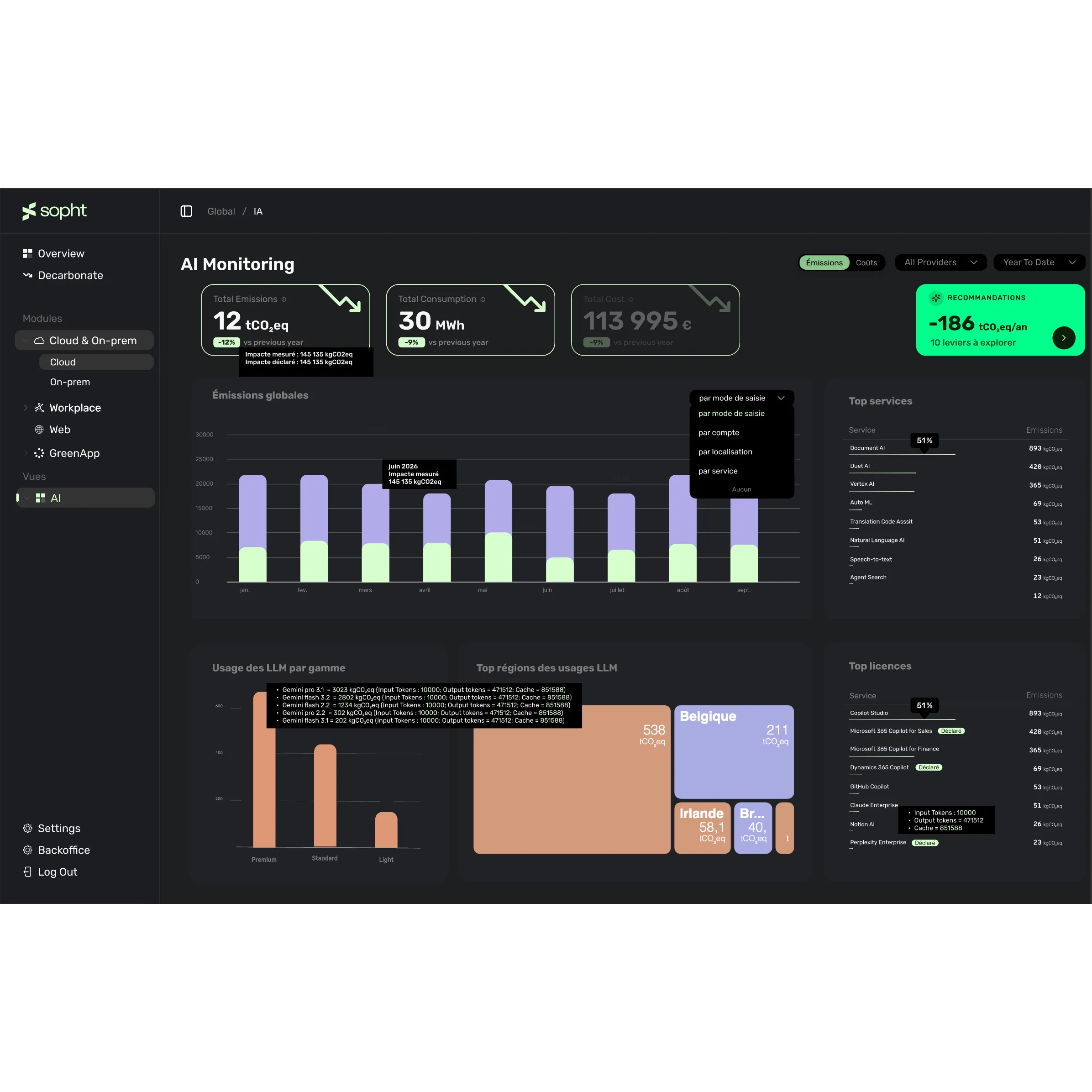
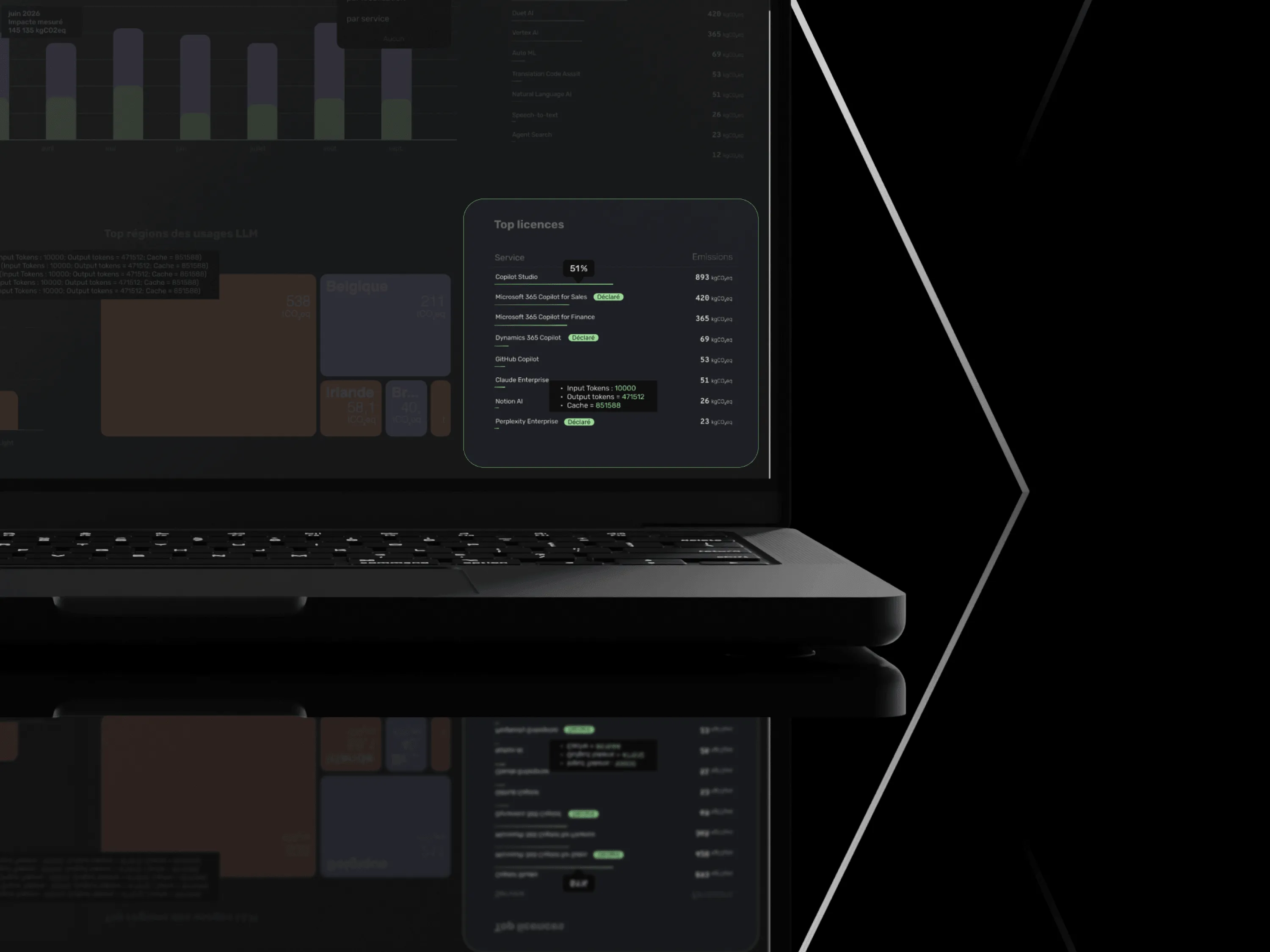
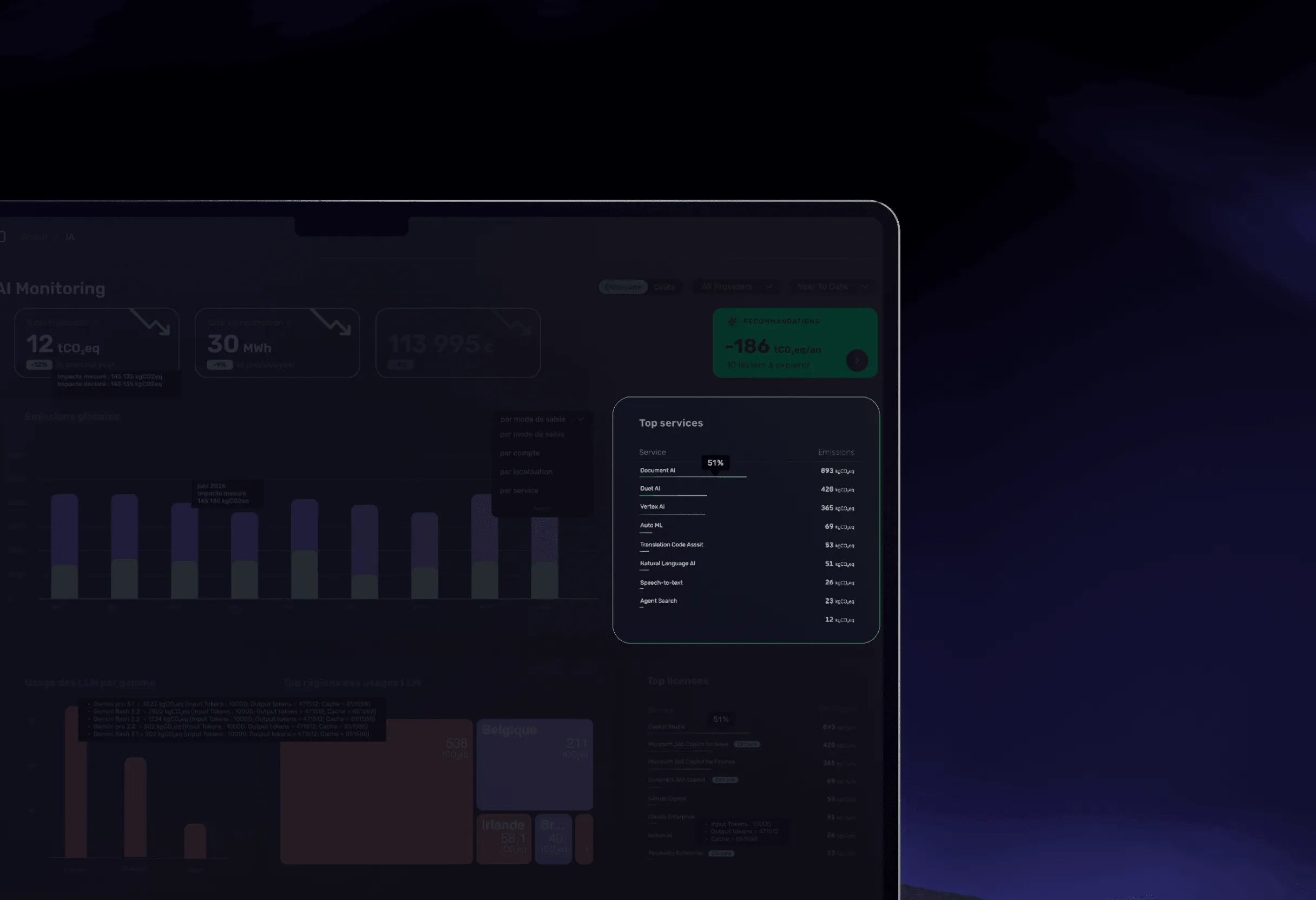
AI MODULE
Bring your AI out of the blind spot
Turn AI from a hidden line item into a steering screen.
CLOUD MODULE
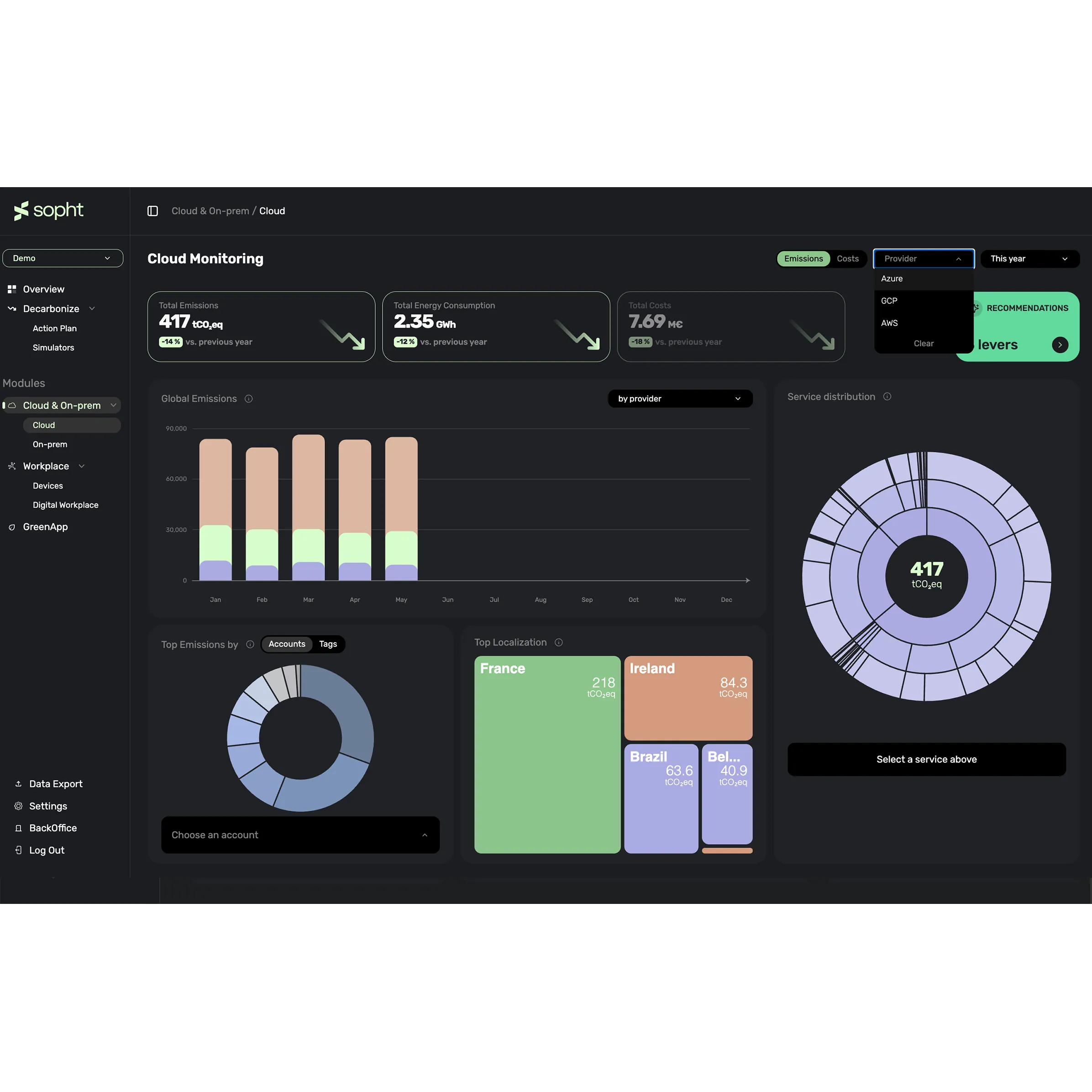
Rationalize your cloud investments
Optimize cloud operations efficiently
.webp)
.webp)
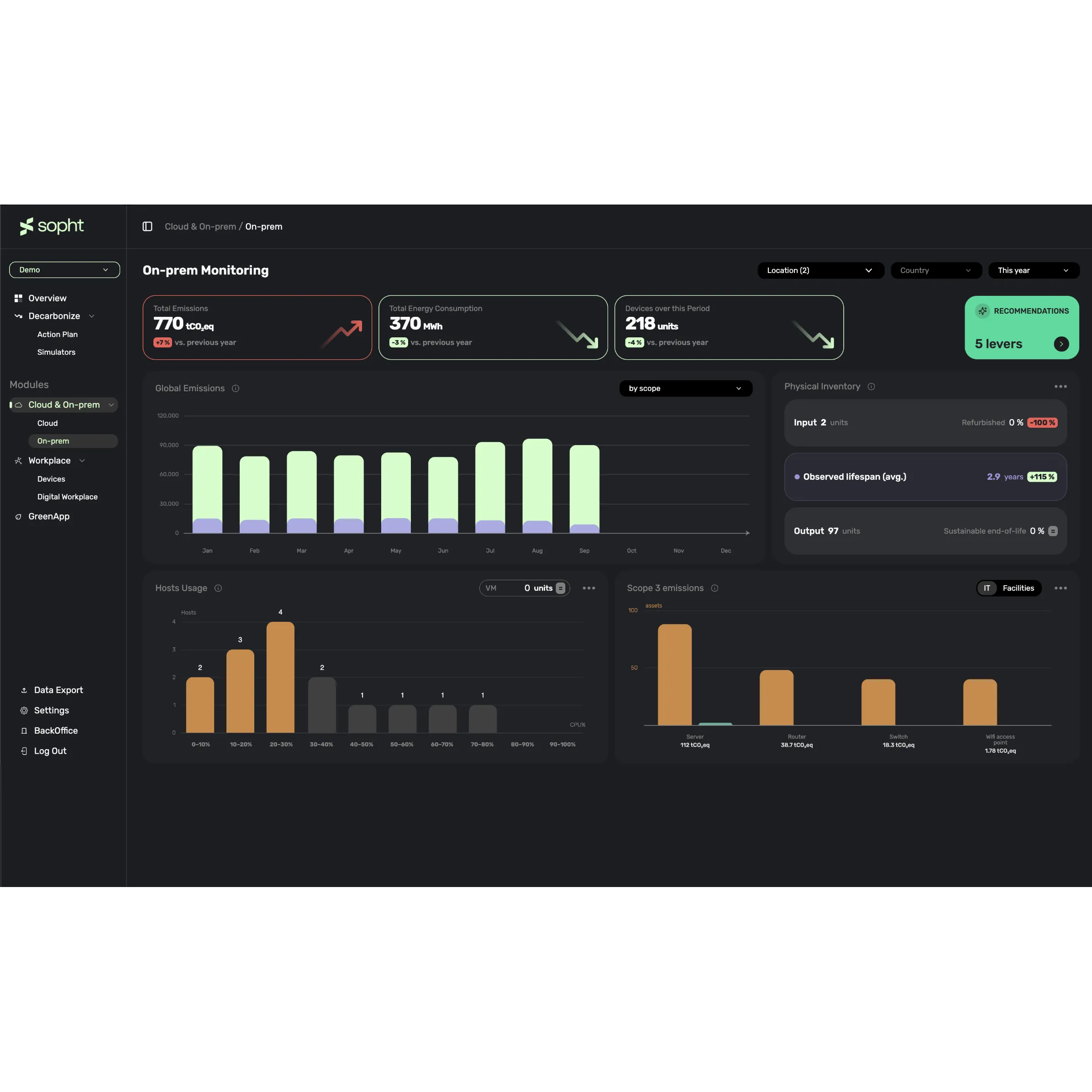
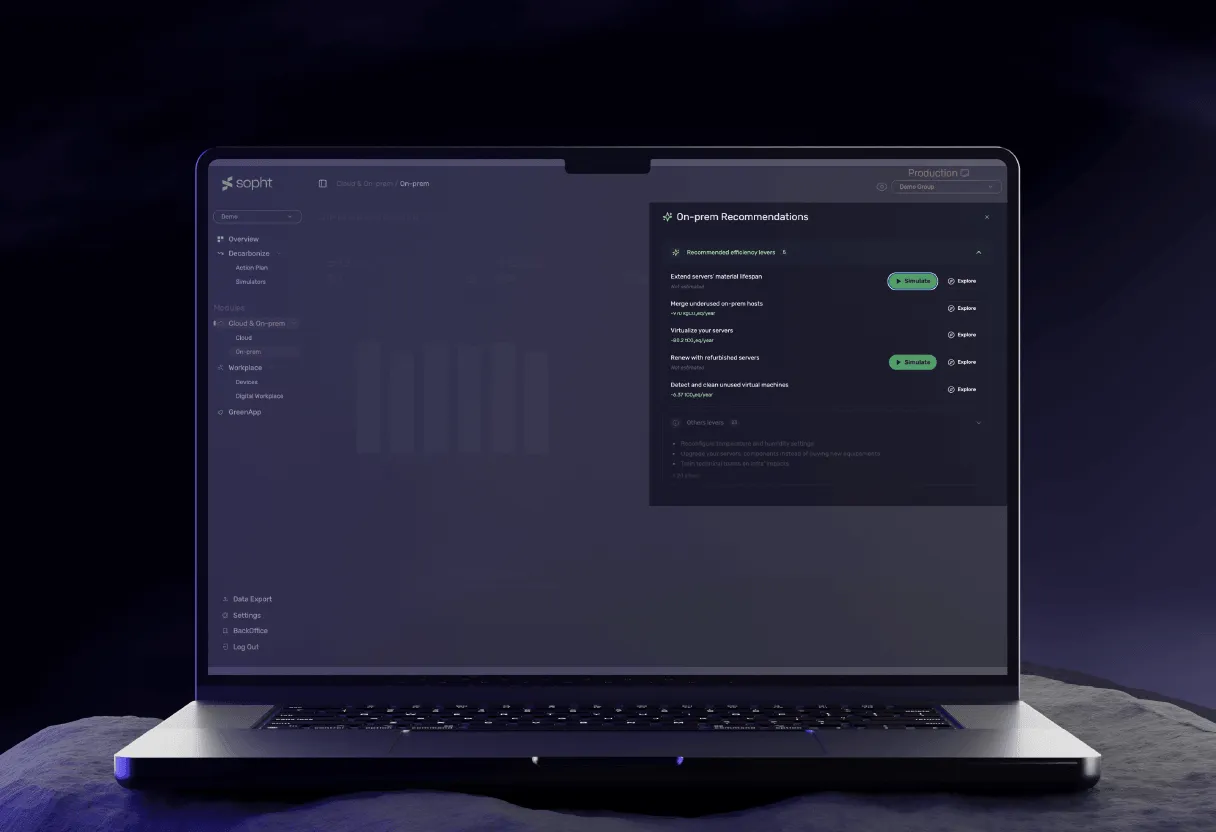
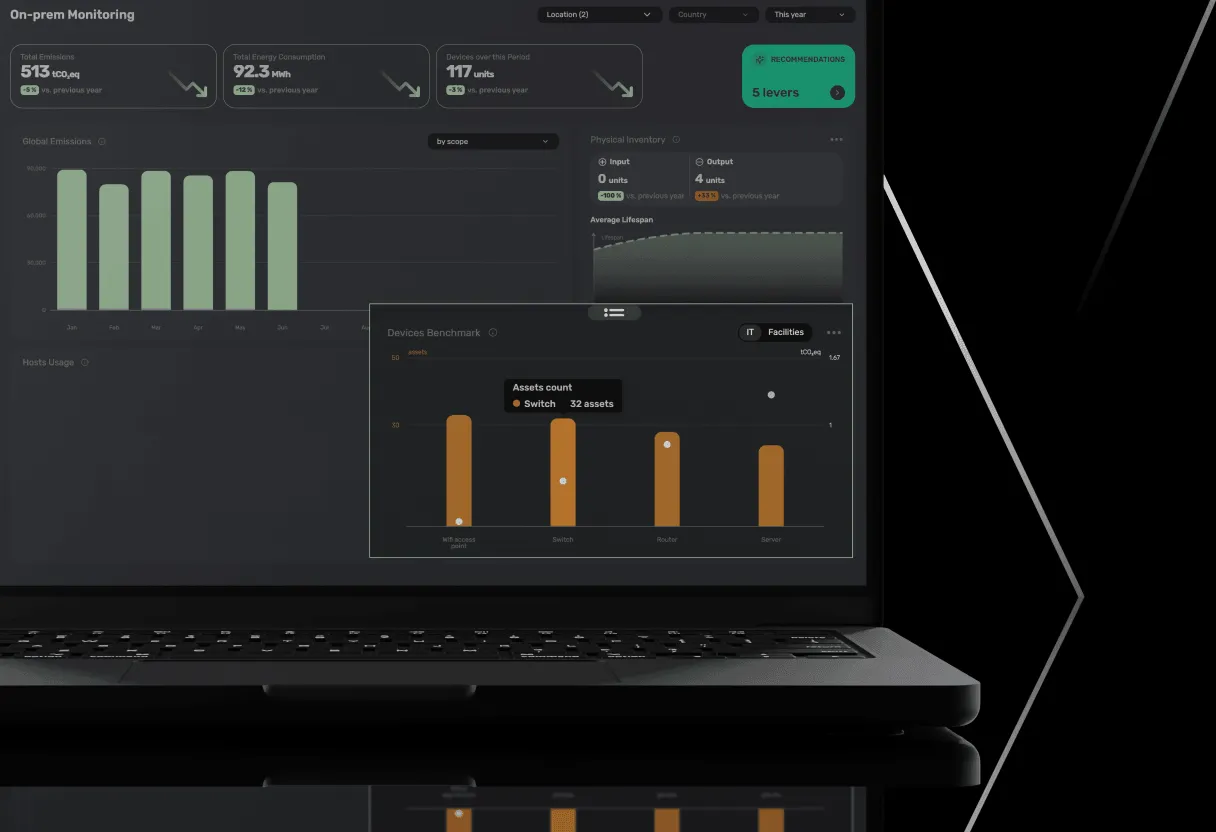
ON-PREM MODULE
Scaling your infrastructure efficiently
Optimize infrastructure with precision
WORKPLACE MODULE
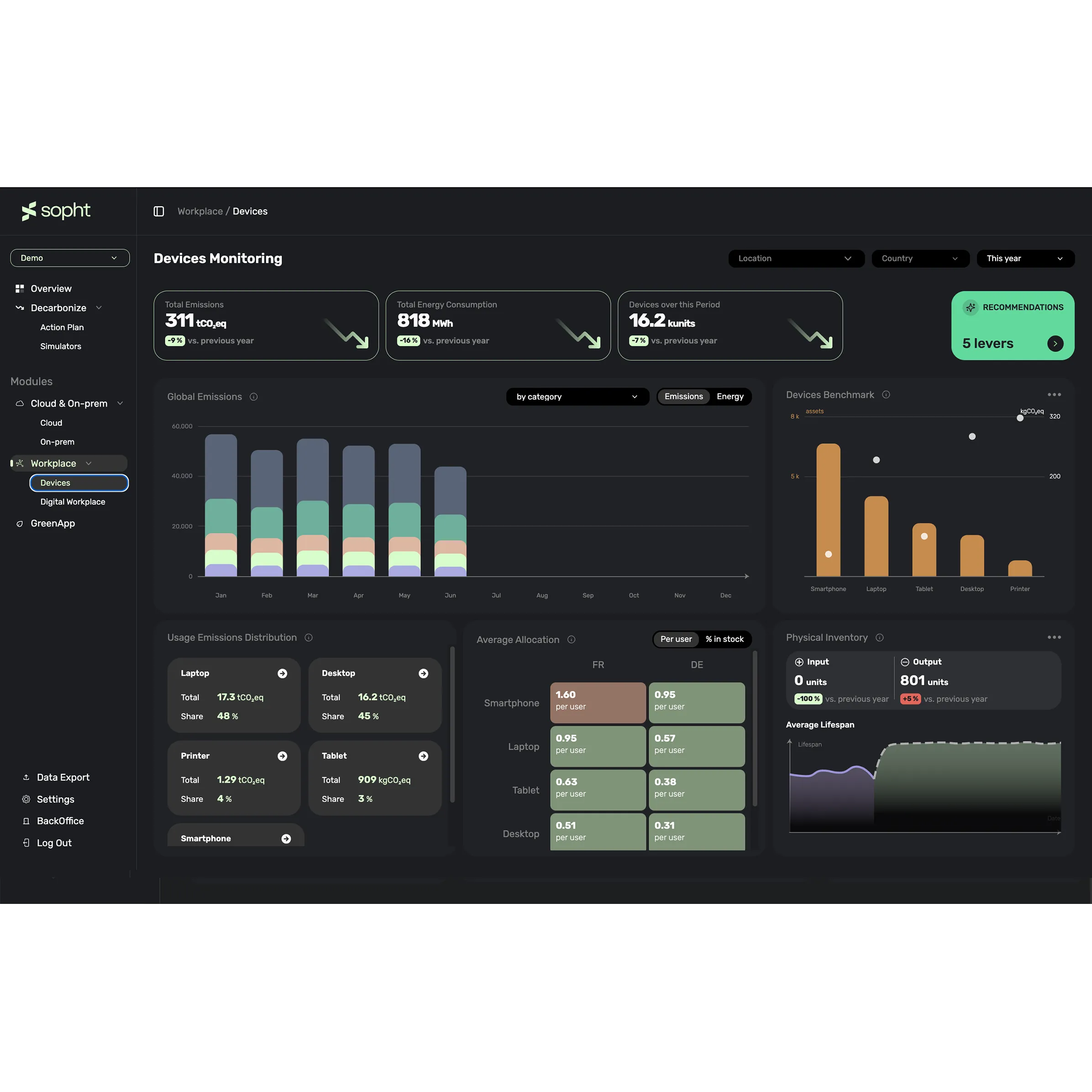
Leaner IT fleet
Turn your hardware inventory into an active optimization engine
.webp)
.webp)
GREENAPP
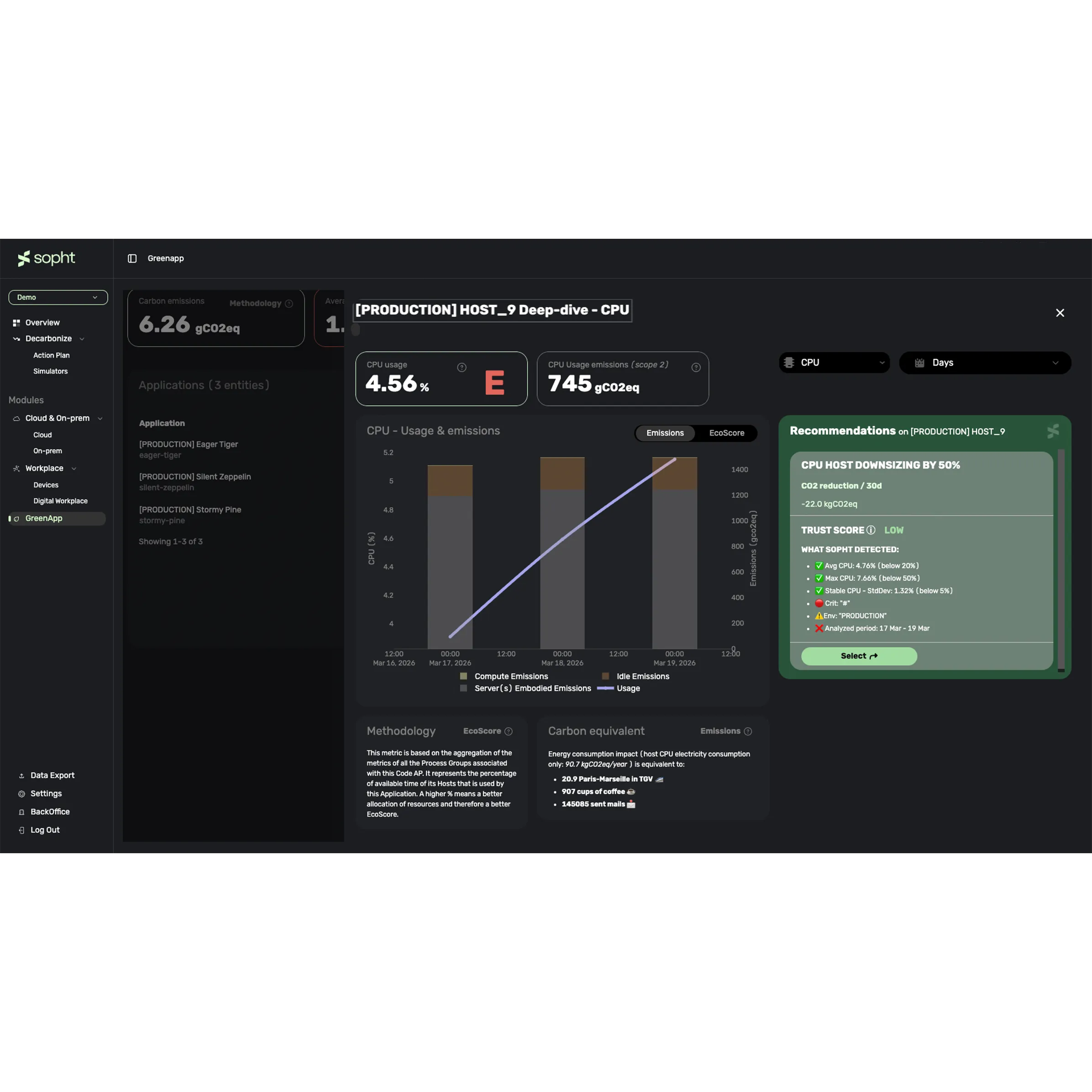
Smarter application resource efficiency
From basic telemetry to active resource reduction
.webp)
.webp)
What you can achieve, in a nutshell
Real-time IT data. Lower spend and emissions. Results you can measure.
Your IT, your role, your benefits.
The same data answers three different questions. CIOs want to know what IT costs and where to cut. Green IT managers want proof that their roadmap pays off. CSR teams want IT figures that hold up in an audit.
Choose your profile and discover how Sopht answers your specific challenges.

CIO / IT Ops
Cut IT spend across cloud, on-prem, devices and AI, and keep budget for innovation.

Green IT Manager
Price every Green IT action in euros and CO₂, and win the arbitration for engineering time.

CSR
Close the IT gap in your carbon report with traceable, audit-ready data.






FAQ
The questions IT and CSR teams ask us first
Cost, data, tooling and audit: the short answers. The full FAQ goes module by module, from cloud to workplace and applications.
See all 35 questionsWhat is IT efficiency management, and how is it different from FinOps or a carbon accounting tool?
IT efficiency management measures what your IT estate costs, financially and environmentally, and turns that view into prioritized actions. FinOps tools optimize cloud spend only, and carbon accounting tools aggregate yearly totals. Sopht reads cost, energy and carbon on the same data, across cloud, on-premises, devices and applications, and keeps the view up to date so teams can act on it.
How do we prove the return on investment to leadership?
Sopht quantifies every lever in euros as well as in carbon. For every euro invested in the platform, clients save four euros on IT operations, and they spend 87% less time collecting data. Simulations can be run before any budget decision to build the business case.
We already use a FinOps tool and our providers' dashboards. What does Sopht add?
Sopht adds the carbon and energy layer to the cost data you already have, so cost and footprint are optimized with the same effort. Cost and carbon do not always move together: a cheaper instance or region can be more carbon intensive. Provider dashboards also stay within one cloud, while Sopht consolidates all of them in one view.
How does Sopht collect data without manual work?
Sopht connects to the tools you already run through read-only connectors: cloud cost and usage reports, VMware, ServiceNow, Dynatrace, Microsoft 365 and others. No agent is installed on your machines. Where no API exists, a structured file import fills the gap, and the platform flags data quality issues so they can be fixed at the source.
What is GreenApp, and what does the EcoScore measure?
GreenApp reads your infrastructure through the lens of each application. The EcoScore, from 1 to 4, compares the resources an application requests with the resources it actually uses, broken down by CPU, memory, storage, network and data center, so oversized applications stand out immediately.
Are Sopht's figures reliable enough for CSRD reporting and audit?
Yes. The methodology is certified against ISO 14064-2 and is visible inside the product, and every figure can be traced back to its source data. The same numbers serve IT decisions and CSRD reporting, so you do not rebuild them once a year.
Cut IT cost. Cut carbon. Be resilient.
Cut what your IT costs and emits, and keep budget for what comes next.

What they say
"At Adecco, we knew that the environmental impact of digital would become a strategic issue, not just to meet regulatory requirements, but to reflect our values. Sopht helped us structure our Green IT approach, automate data collection, and turn an initial intention into a concrete, measurable action plan."
"Measuring and understanding our primary
emission factors is undoubtedly a challenge
in itself, but piloting them dynamically with
concrete action plans is what the Sopht
platform enables us to do."

"From the very inception of our assets, we are committed to minimising the environmental impact of our information systems. Through a strategic partnership with Sopht, we have implemented a solution to quantify the carbon footprint of our applications, thus aligning with the group's 2025 strategic plan."
"Before Sopht, we had no reliable measurement or traceability of our digital footprint. It was difficult to quantify
emissions related to servers, the cloud, networks, and workstations, and to clearly distinguish the
different sources of impact."